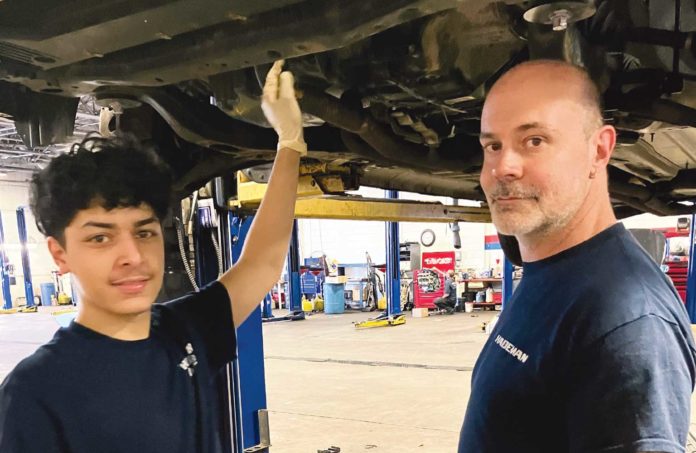

As alumni of the county vocational-technical schools where they are now employed, David Nash and Anthony Bermudez are uniquely suited for their roles as work-based learning coordinators. Their enthusiasm is fueled by their understanding of the benefits to both employers and students who participate.
Such outcomes are also why vocational-technical schools prioritize work-based learning programs: Students can uncover a passion, gain confidence while growing skills and even secure future employment; employers can find a sustainable solution to building a talent pipeline.
Nash, a work-based learning coordinator for Mercer County Technical Schools, and Bermudez, the college and career pathways coordinator for Cumberland County Technical Education Center, are part of a team working across New Jersey’s county vocational-technical schools to coordinate and oversee students’ real-world learning. What is today called work-based learning was previously referred to as cooperative education, or co-op.
Each school structures its work-based learning program slightly differently, but the coordinators generally take on similar responsibilities. They recruit employers and match them with a student who has the skills and interest to contribute as an employee while continuing to learn on the job.
“I think of myself as a mini HR department to vet entry-level talent,” said Nash. “That’s how I describe my role to employers.”
Connecting employers to career-focused students
Nash suggests employers explore a work-based learning partnership by making a brief call to their county vocational-technical school’s coordinator. Contact information for each district appears on the New Jersey Council of County Vocational-Technical Schools’ website, careertechnj.org.
Both he and Bermudez note that relationships with employer partners don’t all start the same way. Sometimes, employers reach out proactively, and, sometimes, students drive the partnership. Students who are already employed may connect their employer and school’s coordinator to determine if they can continue working as part of a work-based learning experience. By enrolling in work-based learning, students can then work part of the school day and earn credits for what they are absorbing in the workplace.
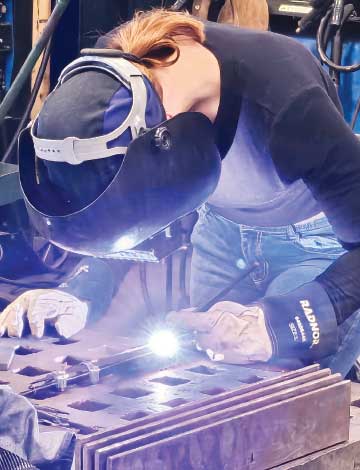
Work-based learning coordinators also spend significant time being proactive themselves to grow employer partnerships in terms of both number of partners and number of industries represented among their partners. This helps ensure all students interested in work-based learning — no matter the career programs they are in — can benefit from a relevant placement.
“We partner with big pharma, mom-and-pop construction companies, car dealerships, manufacturers and high-end restaurants,” said Nash, who is currently pursuing new relationships with the county prosecutor’s office, police departments and law firms. “We want to present opportunities for every student to take a step toward blue collar, white collar, union and nonunion careers.”
Making a mutually beneficial match
Nash said that, regardless of how employers come on board, he takes great care matching them with students. He gets to know the students on his own and talks with their instructors.
Bermudez said that, at CCTEC, instructors and counselors also play a role in identifying students who are interested in and prepared for work-based learning. Such a districtwide approach increases the likelihood that both students and employers benefit from the match.
And, the role of the work-based learning coordinator does not stop when a match is made. The coordinator works with the employer to develop a training plan for the students and frequently visits the workplace to observe the students and discuss their progress with assigned on-the-job mentors. These mentors help provide feedback to students in real time and offer insight for the coordinators’ evaluations and grading.
“For the employer, none of this should be a heavy lift,” said Bermudez. “For the training plan, I don’t want to dictate what the employer needs to teach, but instead help build a plan that focuses on giving students direction so they are someone the employer could and would want to hire.”
He adds that much of the plan incorporates teaching and reinforcing career readiness skills.
Shaping the future workforce
“Work-based learning teaches students so much more than technical skills, such as teamwork, responsibility and critical thinking,” said Bermudez.
Nash emphasizes that these professional skills are often what employers seek in good hires.
And, if employers have a concern about a student’s performance or a question about anything related to the placement, the work-based learning coordinator answers their call.
“Accessibility and relationship-building are what this role is about,” said Nash, who stresses he is available day or night to aid an employer partner.
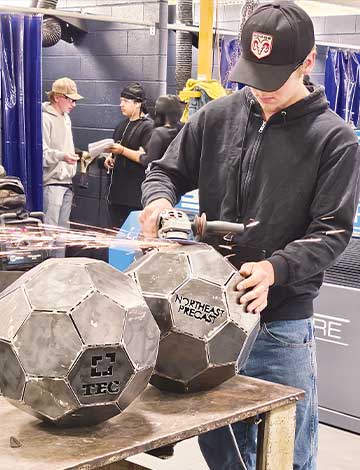
Students are eligible for work-based learning starting at 16 years of age. Because schools structure their programs slightly differently, Nash recommends employers reach out to their county vocational-technical school to discuss timing.
“In my opinion, the best time for an employer to hire is April 1 through Memorial Day to begin onboarding juniors who will start work-based learning their senior year or even over the summer, so students are established in the workplace and all agreements are in place to begin work-based learning early in the school year,” he said.
Bermudez has another message for New Jersey employers: “Anybody in any industry should reach out to a local technical high school and a work-based learning coordinator like myself. This is where your workforce is coming from. Our students in our career and technical education programs have not yet formed bad habits and are ready to learn the good ones you want your employees to have. They have trained on the same equipment and technology you use over the last four years in their career and technical education programs. They have their OSHA 10 certification. They are your future.”
Nash said the return on investment for employers is invaluable, adding, “You are establishing a never-ending pipeline of talent.”
Conversation Starters
Any employer interested in connecting with a county vocational-technical school
to explore work-based learning partnerships can start by filling out the form available
at careertechnj.org/become-an-employer-partner/.
Mercer County employers can contact David Nash at 609-737-9784, ext. 2030,
or dnash@mcts.edu.
Cumberland County employers can contact Anthony Bermudez at 856-451-9000, ext. 3209, or abermudez@cctecnj.org.
This series on education and industry is presented by the New Jersey Council of County Vocational-Technical Schools.