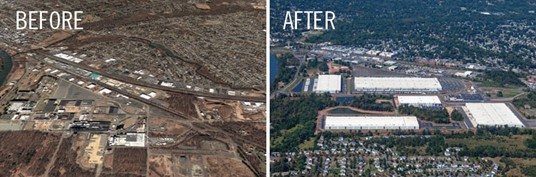
New Jersey has long faced a common stereotype from out-of-staters: that the Garden State consists solely of twisting highways, oil refineries, smokestacks, shopping malls, and contaminated land. However, it is essential to remember the vital role New Jersey has played in manufacturing and industrial development in America over the past two centuries. Paterson led the way as the country’s first planned industrial city, centered around the Great Falls of the Passaic River. The city developed methods for harnessing hydroelectric power for industrial use, establishing factories that enabled the U.S. to become a significant economic player on the world stage. During the early 1800s, New Jersey flourished, with new factories emerging throughout the state. Paterson became a textile center and later gained recognition for producing trains and silk. Trenton specialized in clay products, iron, and steel, while Camden, Elizabeth, Jersey City, Newark, and Passaic all emerged as major manufacturing hubs. Today, New Jersey remains a vital player in manufacturing, leading in the worldwide supply chain and logistics. However, the state has paid a steep price for its industrial success, leaving behind contaminated land, polluted waterways, and air quality issues. How much progress has New Jersey made in cleaning and remediating these sites to make them free of contamination and ready for productive use? Over the next few weeks, ROI-NJ will publish a series of articles on the state’s Brownfield program, created in 1998 when the New Jersey Legislature passed the “Brownfields and Contaminated Site Remediation Act.” The series will highlight Brownfield Development Areas (BDAs) in northern, central, and southern New Jersey. What is a Brownfield? Under New Jersey state law, a brownfield is defined as “any former or current commercial or industrial site that is currently vacant or underutilized and on which there has been, or there is suspected to have been, a discharge of a contaminant.” Successfully facilitating real estate investment projects on brownfield sites is viewed as critical to improving New Jersey’s environment and economy. A BDA represents a collection of properties in communities that work together rather than separately, explained Frank McLaughlin, manager of the Office of Brownfield and Community Revitalization. “Our goal is always to redevelop a site for future use after a contaminated property is remediated,” he said. Currently, there are BDAs in 26 municipalities, with 13 additional sites in the process of being added across 10 municipalities. “How do we measure success?” “Success is getting a property that has been contaminated remediated so that there is no longer any risk to public health. That is always a great success, and then redeveloping those properties into a useful part of the community—a park, a place to work, a place to live, whatever it may be,” said Gwen future vision,” he said. Zervas acknowledged that these projects are challenging, often involving some of the largest and most contaminated areas. However, she emphasized that collaboration significantly increases the chances of success. “You could have three different industries on a block working together, rather than separately. It revitalizes a community on a larger scale,” she said. “We have been very proactive in identifying sites and remediating them, requiring responsible parties to conduct cleanups. When they are unable or no longer exist, or if a municipality owns the site, we apply for grants,” Zervas added. The largest site under development in the state is the former NL Industries 418-acre site in Sayreville, along the Raritan River, which is the future home of the $2.5 billion Riverton retail and residential community. Just this week, Congressman Frank Pallone Jr. (NJ-06) and New Jersey Speaker Craig Coughlin sent a letter to NL Industries demanding immediate action to address toxic pollution left in the Raritan River near the company’s former titanium dioxide facility. The letter follows recent sediment analysis, which confirms elevated concentrations of arsenic, copper, lead, nickel, and zinc in riverbed samples—levels exceeding safety thresholds established by the New Jersey Department of Environmental Protection (NJDEP). “It is unacceptable that, more than 40 years after ceasing operations at the Sayreville plant, your company has still not remediated its toxic legacy,” Pallone and Coughlin wrote.
“Your latest report relies on shallow sediment samples—just 6 inches to 2 feet deep—in a river channel that, in some places, exceeds 15 feet. This limited methodology is inadequate and fails to address the full extent of contamination. Furthermore, dismissing the results as typical for an ‘urban river’ does not relieve your company of responsibility, especially given NL Industries’ well-documented history of environmental violations across New Jersey.”
In their letter, Pallone and Coughlin noted that in 2009, environmental advocates filed a federal lawsuit to compel a cleanup, and in June 2024, a federal court found NL Industries responsible for contributing to the contamination. Yet the company still has not taken significant steps to remediate the site. The lawmakers urged NL Industries to conduct deeper sediment sampling, release all current and historical data, submit a detailed remediation plan, and commit to a full cleanup in coordination with regulators and the community.
“Generations of New Jersey families have paid the price for NL Industries’ pollution. It is long past time for your company to do the right thing—and clean up what it left behind,” the lawmakers wrote.
According to Greg Rogerson, a principal at J.G. Petrucci Co., which focuses on industrial and multi-family redevelopment, cleaning up sites often requires addressing some level of environmental contamination to meet DEP standards.
“I would say that 95 percent of everything we touch has an environmental component to it—a former industrial site with some type of contamination,” he said.
“There’s been significant development over the past 100 years, and if you consider the location—close to major cities like New York, Philadelphia, Boston, and Washington, D.C.—it plays a critical role in the region,” Rogerson said.
“You are taking sites that were built at the turn of the century, when there were no environmental statutes and standards in place, and bringing those sites back up to standards that were developed from the 1970s to 2000,” Rogerson said.
He noted that regulations have become much more stringent over the years.
“New Jersey is a very sophisticated state. It wants to see sites cleaned up to a higher standard. There are a lot of hoops to jump through, but by and large, regulators are smart and just want to see a cleaned-up site,” Rogerson said.
He added that most sites are located in areas with higher infrastructure—near highways, airports, transportation hubs, rail lines, and hospitals.
“One thing environmental conditions create in the business world is imperfection pricing—someone has a property, and they don’t want to clean it up, but they are willing to sell at a discounted price to those who will do so. There are also state-funded programs to reimburse some of the costs. But by and large, having the skill set and willingness to go through the bureaucratic process of getting a site cleaned up is where value is created.”
Up Next: ROI-NJ speaks with Piscataway Mayor Brian Wahler about the impact the Brownfield program has had on the township and its residents, including an increase in ratables and the development of a new 33,000-square-foot community center.