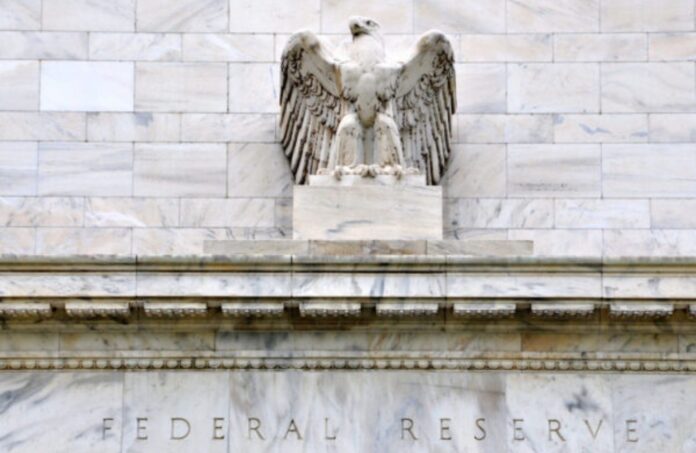
The Federal Reserve voted Jan. 28 to hold the federal funds rate steady after lowering it three consecutive times since Donald Trump became president.
The decision to hold the benchmark federal-funds rate steady in a range between 3.5% and 3.75% was approved by a 10-2 vote.
In its announcement, the central bank acknowledged that the economy has been expanding at “a solid pace.” Job gains have remained low, and the jobless rate “has shown some signs of stabilization. Inflation remains somewhat elevated.”
The Fed decided to adopt a wait-and-see posture in the wake of those considerations. The central bank said its mandate has been to steer the economy between seeking to achieve maximum employment and keeping inflation at the rate of 2% over the longer run.
“Uncertainty about the economic outlook remains elevated,” the bank said. “In support of its goals, the Committee decided to maintain the target range for the federal funds rate at 3‑1/2 to 3‑3/4 percent.”
The two dissenting votes at the meeting belonged to Stephen I. Miran and Christopher J. Waller, who preferred to lower the target range for the federal funds rate by 1/4 percentage point at this meeting. Miran has been the most hawkish of committee members. He has dissented at all four policy meetings he has attended in favor of lower rates.
The Fed has been something of a pinata for President Trump, who has been pushing for the central bank to lower rates. The Justice Department earlier this month opened a criminal investigation into Fed Chair Jerome Powell, who in an unusual action publicly disclosed the probe in a video statement saying the president was using the investigation to further Trump’s desire for lower interest rates. Powell’s term ends in May; Trump has not named his successor.
The direction the Fed takes on the benchmark rate depends on how the economy performs. The federal government is playing catch-up in collecting economic data because of the 43-day government shutdown beginning Oct. 1.
In regard to the latest figures, gross domestic product rose 4.4% in the third quarter of 2025, according to the updated estimate released by the U.S. Bureau of Economic Analysis. In the second quarter, GDP increased 3.8%. The increase in real GDP in the third quarter reflected gains in consumer spending, exports, government spending and investment. Imports, which are a subtraction in the calculation of GDP, decreased.
Nonfarm payroll employment (up 50,000) and the unemployment rate (4.4%) changed little in December, according to data from the U.S. Bureau of Labor Statistics. Employment trended up in food services and drinking places, health care and social assistance; retail shed jobs.
In December, the Consumer Price Index rose 0.3%, seasonally adjusted, and increased 2.7% over the last 12 months, not seasonally adjusted.
On Jan. 28, Bankrate reported that the current average interest rate for a 30-year fixed mortgage is 6.18%, the lowest level in more than three years.