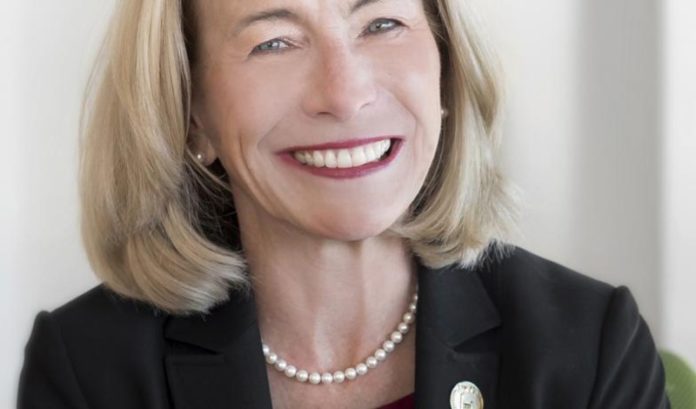
Longtime New Jersey City University President Sue Henderson understood the timing of the announcements was not going to look good.
That’s what happens when word that a university president is leaving comes out just minutes before the school announces that it is making a declaration of a financial emergency and will be operating under an interim budget.
But Henderson, who spoke to ROI-NJ in an exclusive interview Tuesday morning, said there was no way around the timing of the news that broke Monday night — and that neither announcement had anything to do with the other.
The reason? Henderson had informed the board months ago that she would not be returning after the end of her contract (which expires June 30), but she said she wanted to hold off on the news until the state budget was finalized in Trenton. That happened Monday. (School officials confirmed the sequence of events.)
NJCU, Henderson said, had asked for additional millions to address some of its ongoing financial issues, and she didn’t want to have the school be seen as being in any type of limbo while the budget was being decided.
Read more from ROI-NJ:
- Henderson resigns as president of New Jersey City University
- New Jersey City University declares financial emergency; board adopts interim budget
“I wanted to make sure that what we needed in the budget got put in the budget,” she said. “And I didn’t want the state to feel like that, with a presidential transition, they could say, ‘Oh, well, we’ll let NJCU have a bye this year’ and not do anything. So, I needed to push to the last day, and I think we’re getting something extra, which is good.”
It remains to be seen how much extra funding NJCU will receive. The reality, however, is that it won’t be enough to avoid changes. Henderson said the school will be forced to cut some classes, programs and personnel — do all of the things other financially strapped schools in the state already have done, she said.
The school, she said, will begin working with the unions Tuesday — something they will have greater flexibility to do now that a financial emergency has been declared.
“That’s the way things work with the union contracts,” she said.
Henderson, who is finishing up her 10th year at the helm — making her one of the longest-tenured university presidents in the state — said she still feels the school’s future is sound and secure. And she does not see any reason why NJCU would need to waver from its mission of educating mostly first-generation students from underserved communities.
These cuts, she said, are just a necessary evil during tough economic times.
“I think what this will do — because I’ve seen a couple of institutions go through this — is make NJCU spend a few years tightening their belt, getting rid of the fat, and it will come out stronger,” she said.
“I think the things that are strong, like the School of Business and the arts programming, will remain strong. I think (the recently opened satellite campus at) Fort Monmouth will eventually take off.
“And I think the commitment to serving the underserved community will be as strong as ever.”
Of course, these decisions will be made by the board and the next president.
NJCU announced Monday that Jason Kroll, the school’s vice president and chief strategy officer, will serve as interim president. Kroll said he does not want to be considered for the full-time post.
Here’s a look at more of the conversation with Henderson.
ROI-NJ: The ‘financial emergency’ declaration came as a shock to many people. Was this a surprise internally? Does this put NJCU in the same position as Bloomfield College, which recently announced it was in danger of closing before working out a partnership with Montclair State?
Sue Henderson: This is not a Bloomfield situation, but it is not a new situation either. We’ve had a $15 million structural deficit for three years now. I looked at the then-CFO (Jim White) and said, ‘Let’s use the COVID money to help — and tell us where to take a diet so we can get the reserves back up and get us in a stronger position,’ but it wasn’t enough.
We cut $4 million one year and another $3 million the next, but we cut while we were losing enrollment, so anything we cut would get eaten up by that drop in enrollment.
ROI: NJCU had an enrollment as high as 6,663 in 2016-17. It dropped to 5,262 this year, despite the fact that its in-state tuition (approximately $15,000 before any aid) is one of the lowest of any four-year school in the state. Talk about the challenges that come with such a steep drop?
SH: The pandemic really brought to light a few facts: One is, if you’re a poor student, you’re less likely to go to school when things are bad. Last fall, the four schools that lost the most enrollment were three community colleges (in Hudson, Passaic and Essex counties) and NJCU.
Our student profile has the same economic, not academic, but same economic profile as those three community colleges. That impacts how you operate.
ROI: How so?
SH: When you know that your student body comes from very modest means and that they need a lot of support, you don’t want to give up those things. It’s important for you to keep the support structures in place for the students. So that’s not something you’re going to cut out. We need to say: ‘Where are the places we can cut. What do we need to do?’
ROI: We’ll ask: What are those areas — and how will the school make cuts?
SH: Because the school declared a financial emergency, we can do this in a more surgical way, not just cuts across the board. I’m meeting with the deans today and now can say something like, ‘The basket weaving department isn’t doing as well anymore, it doesn’t have the same enrollment, so we don’t need as much in the that department anymore.’
And we may not have as many sections, so our classes may be a little bigger. There’s a lot of things you can do in the business model to help you save money.
ROI: That, of course, includes reducing personnel through layoffs or reducing payroll through salary cuts or furloughs. How many people could be impacted by this?
SH: It’s too early to come up with a number, but we’ve already started getting concessions from the union, because we knew our budget was not good. This is a situation that has happened across the state. They have done it at William Paterson, at Kean and at Rutgers.
ROI: What’s next for you? Are you retiring?
SH: I’m not. I will begin looking for my next challenge. I’ve already had a couple of interviews, though, I have to say, I couldn’t really get into it until I was able to finish my role here.
ROI: Are you looking for another job as a president?
SH: I could do that, or I could go into policy. And I may not do anything for a while. There are going to be a lot of presidential searches this year.
ROI: Do you want to stay in New Jersey, where you’ve worked the past 10 years?
SH: It really doesn’t matter. My kids live in Boulder, Colorado, and Charleston, South Carolina. So, those are kind of draws. But, if there was something here, I’d be interested. I love New Jersey. I feel like I know the politics and the business community. And I’ve made a lot of contacts.
ROI: Final question: Take us through the decision to make both announcements on the same day at approximately the same time?
SH: It’s funny, I told the board, I don’t want to do the announcement until after we know that the budget is set. Well, the budget got set yesterday. And then, because we had to in the board meeting yesterday, declare this emergency, we knew we had to put a press release about that, too.
So, the board chair, Joe Scott, says, ‘This isn’t going to look good.’
I said, ‘Joe, name me a college president in the state or in the country that hasn’t been dealing with emergency financial situations.’ That’s the reality of higher education today.