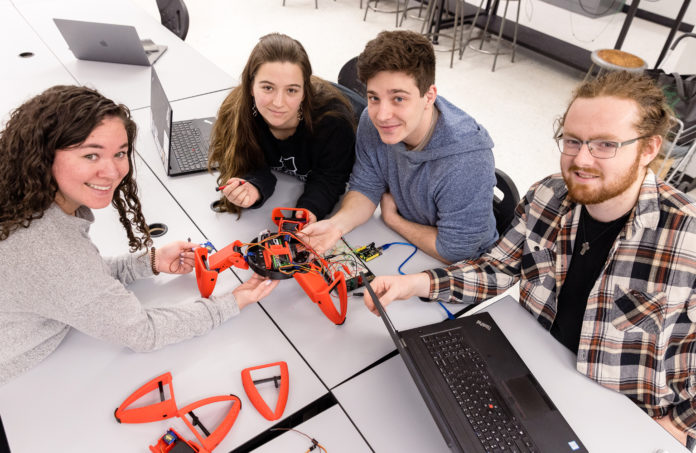
Have you ever stopped to wonder what keeps the world humming? What makes society tick? Drives the economy? If having humanity’s knowledge base in the palm of our hand, access to advanced health care technologies and the ride under the Hudson River to the financial capital of the world are assumed conveniences, then consider this: These essential features of daily life were all designed, tested and built by engineers.
Harvesting the toxic blooms of summer
In the 21st century, demand for engineering innovation in every facet of our lives is multiplying. Summer vacations at the lake, for example, are now threatened by proliferating toxic algae blooms that also kill wildlife and deplete oxygen in the water. Wen Zhang, environmental engineer and director of New Jersey Institute of Technology’s Sustainable Environmental Nanotechnology and Nanointerfaces Laboratory, has been working with a team of biologists, engineers and entrepreneurs on a new plan of attack to fight the micrometer-sized invasion using nanobubble technology.
His technology injects nano- and microbubbles of negatively charged air to adhere and lift the algae from as deep as 4 feet below the surface, where it is then collected by skimmers. Nanobubbles are widely useful. Suspended in liquids, they have a high degree of stability against dissolution and collapse. Their large surface area and random movements allow them to move nutrients around to enhance plant growth, disinfect bacteria and aerate hypoxic environments.
With successful prototyping and testing demonstrating its success, Zhang’s technology has been licensed by the startup PureNanoTech Inc. through NJIT’s entrepreneurial incubator, New Jersey Innovation Institute. Zhang, who is a senior consultant to the company, said it is designed for diverse applications, including in agriculture, where he hopes to reduce the amount of synthetic fertilizer used in crop growth by deploying it more precisely. In this instance, he says, the bubbles “attract positively charged mineral nutrients in the soil such as calcium and potassium, mobilizing them and promoting their uptake. They also stimulate plant genes that control the production of growth hormones.”
Nanobubble technology is being used to improve food and plant growth industries as well. As natural resources — water and space — become strained, controlled environmental agriculture offers an energy efficient, ecologically conscious process with nanobubble tech believed to improve plant growth and crop yields in soil-based and hydroponic systems.
Keeping the trains on the tracks
In the face of powerful storms, fast-spreading wildfires and global pandemics, communities are discovering their vulnerabilities when they can least afford it. Before you can build resilience to both natural and human-made catastrophes that affect lives and livelihoods, community leaders need to first understand where and how they are vulnerable. Engineers to the rescue.
 “We need to rethink what it means to be resilient. I use the boxing analogy ‘roll with the punches’: the ability to absorb the shocks of extreme events and recover quickly,” says Michel Boufadel, the director of NJIT’s Center for Natural Resources. “But, to do so, the whole system needs to work together. It doesn’t matter if the power stays on, but 90% of the roads are closed.”
With collaborators at Rutgers University and Princeton University, Boufadel has developed a Community Intrinsic Resilience Index, or CIRI, that will help cities and regions reduce the potential impacts of natural disasters by making strategic investments in infrastructure. The researchers assess resilience in four key sectors — transportation, energy, health care and socioeconomics — they deem important to remaining productive and quickly returning to normal. The team evaluates disaster-relevant factors in each sector and assigns values to them with thresholds.
The group recently computed CIRI scores for counties in New Jersey, which ranged between 63% and 80%, based on preliminary data. In the study, a post-disaster CIRI calculation following projected major flooding revealed that the transportation and socioeconomic attributes of two coastal counties would fall below specified thresholds due to projected road closures and harm to local economies.
Their goal, Boufadel says, is to help local leaders and other policy-makers integrate resilience within the planning and design phases of disaster management: “There is not enough money to avoid harm entirely, and decision-makers need numbers in order to prioritize spending.”
An environmentally friendly economic opportunity
Managing waste sustainably, from discarded construction materials to consumer products, is one of society’s greatest challenges. On the roof of NJIT’s Campus Center, speckled slabs composed of recycled glass and plastic bottles have successfully weathered the first leg of a yearlong stress test.
“We’re seeing how this composite withstands ultraviolet light, fluctuations in temperature, freezing and thawing cycles, rain and snow,” explains Richard Marsh, who recently received a master’s degree from NJIT in environmental engineering. “So far, there’s no crumbling or cracking.”
 Marsh represents an effort by engineers and architects who hope to develop innovative construction products from mixed-color container glass that “go beyond the tried and tested paving materials or cementitious composites.” Think architectural façade elements or landscaping products such as planters, pavers and retaining wall blocks.
“We’re trying to find a use for mixed-color glass without going through all of the processing that now occurs when it’s ground into fine powder and used as a replacement for sand in concrete,” he says. “We use it as an aggregate.”
Marsh’s group argues that manufacturing new glass products utilizing recycled glass requires 20% less energy and creates 20% less air pollution than glass produced from virgin materials.
However, only a quarter of the glass Americans use is currently recycled. Separating glass, either at home or at a facility, is still a cumbersome and expensive process.
“The system is in place and it’s hard to change that,” Marsh says. “If you’re recycling, you think you’re doing a good thing. If we tell you that it’s mostly going to a landfill, you might be demoralized and possibly recycle less.”
Manufacturers don’t use recycled mixed-color glass to make new containers, because, when it’s melted together, it becomes the color of mud.
“The material’s surprisingly high compressive strength and durability, coupled with its unique speckled look,“ Marsh says, ”may make it a popular commodity in an environmentally-conscious future.”