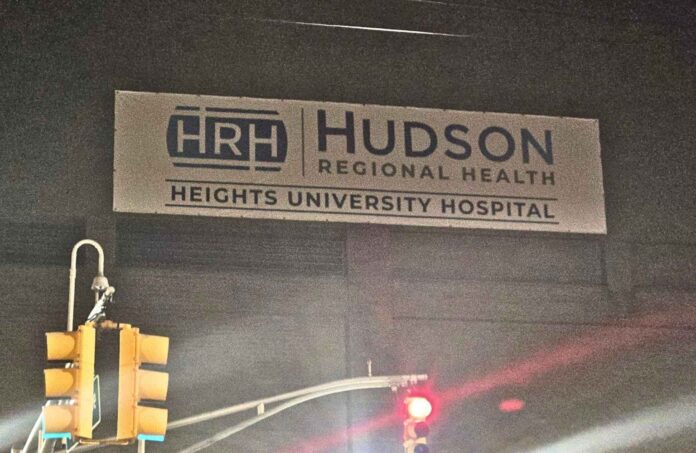
Hudson Regional Health told Jersey City officials that it is closing the emergency department of Heights University Hospital, shutting the last functioning unit of the community hospital that was founded in 1872 as Christ Hospital.
Hudson Regional Health said Feb. 27 the emergency department will remain open through March 14. Emergency department services are anticipated to be suspended at that time unless alternative funding to fund operations are secured through the New Jersey Department of Health, or other sources.
HRH told the New Jersey Department of Health that it planned to suspend emergency department operations as of Saturday, Feb. 28. However, after requests from Jersey City elected officials and discussions with Department of Health Commissioner Dr. Raynard Washington, HRH Chairman Yan Moshe agreed to pay for the costs associated with emergency department operations for the next two weeks of about $1 million.
Newly elected Mayor James Solomon said in a statement that the potential closure of Heights University Hospital was “unacceptable, especially since just a year ago, their CEO said that the future is bright for patients in the Heights. I will use all my power to reverse this decision. We are in active conversations with Gov. Sherrill, the NJ Department of Health, our state legislative delegation, and HRH regarding options to save access to health care in the Heights. Every option, from emergency injunctions to transferring the license, must be on the table.”
The facility downsized in November after Hudson Regional Hospital said the health care group was turned down by the state a day earlier to get $25 million to continue operating and it kept the emergency department running. HRH said even after downsizing to primarily emergency department services, Heights University Hospital was still projected to lose more than $30 million this year.
This follows losses of $74 million between November 2024 and December 2025 claimed by the company, which also has health care facilities in Secaucus, Bayonne, and Hoboken. HRH assumed operations of Christ Hospital (renamed to Heights University Hospital) in November 2024 after prior owner CarePoint Health’s previous filing for bankruptcy.
HRH said as of March 14, it will relocate existing health care workers who wish to be placed within the system at Secaucus, Bayonne or Hoboken; place an ambulance outside the Heights Emergency Department for two weeks; and deploy a mobile health unit following that period to provide various levels of care.
Debbie White, president of the Health Professionals and Allied Employees (HPAE) that represents union workers at the hospital, said in a statement that “We call on state officials and regulators to act now: hold HRH accountable, demand full transparency, and ensure a thorough public review before any major changes are implemented. The health and well-being of our community is at stake.”
HRH assumed operations of Christ Hospital (renamed to Heights University Hospital) in November 2024. This followed CarePoint Health’s previous filing for bankruptcy. HRH said after it took over the hospital it was faced with tens of millions of dollars of liabilities, vendor underpayments, unpaid wages to essential health care workers, and a system that had been drained of resources and a loss of physician relationships.
Despite investing what it said were $100 million to try and financially stabilize the hospital, HRH said Heights University Hospital’s losses of $74 million severely strained resources across the HRH network. The hospital network also cited unforeseen factors including drastic cuts to Medicaid and other critical funding initiated by the One Big Beautiful Bill, the cutting of Charity Care at the state level, and a rising rate of uninsured patients.
Despite the anticipated suspension of emergency department services, HRH said it has informed Jersey City of its desire to pursue redevelopment opportunities in the coming months that would support the construction of a new, financially sustainable hospital. HRH said a new, state-of-the-art building would allow the network to recruit new physicians and expand service lines to generate needed revenue.