Atlantic Health recently introduced new tools designed to detect cardiovascular disease in even the most often-overlooked blood vessels in the heart – an advancement that can help more people with chest pain syndromes to be treated.
The CoroFlow Cardiovascular System with PressureWire X Guidewire, available at Atlantic Health Overlook Medical Center and soon to be introduced at Atlantic Health Morristown Medical Center, provides a comprehensive assessment of coronary physiology.
This platform by Abbott conducts a full physiology assessment of the coronary vasculature — including the major epicardial arteries and the coronary microvasculature.
These tools can assess whether patients presenting with recurrent angina symptoms may be suffering from coronary microvascular dysfunction (CMD), an often-overlooked disease in which the smallest vessels of the heart have abnormalities not detectable on an angiogram.
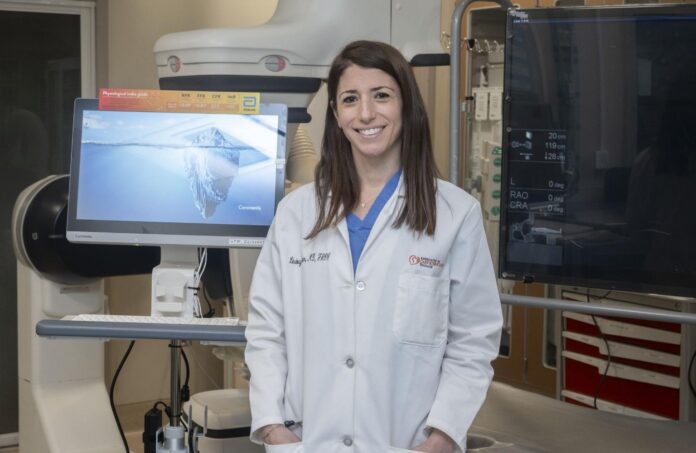
Interventional cardiologist Dr. Lindsay Elbaum, who recently joined Overlook’s cardiology team, has been using CoroFlow for more than four years and said it has helped offer solutions to patients whose chest pain could be missed by traditional angiograms alone.
“More than half of patients who are referred for angiograms for the evaluation of chest pain do not have significant coronary artery disease. Many may have coronary microvascular dysfunction or coronary vasospasm,” Elbaum said.
“CoroFlow opens the door to answers that will provide patients with not only a diagnosis but also treatment options,” Dr. Elbaum said. “Even in cases in which patients receive a negative result, the comprehensive nature of the system delivers peace of mind that their chest pain may not be from the heart.”
The treatment of angina has traditionally focused on disease in the three major arteries running on the surface of the heart, but those three vessels provide less than 10% of the actual blood supply to the heart muscle. The rest comes from smaller vessels, or microvasculature, most of which are too small to be directly visualized. CMD can be assessed in the microvasculature by measuring blood flow.
The CoroFlow Cardiovascular System uses pressure and temperature data from Abbott’s PressureWire X Guidewire to estimate the blood flow in the microvasculature, allowing physicians to make an informed assessment of the cause of their patient’s recurrent angina. An informed diagnosis is critical in optimizing patient treatment strategies in order to improve patient outcomes and quality of life.
The journey from first experiencing symptoms to an accurate and informed diagnosis can be long and arduous for those patients suffering from CMD. Warning signs of CMD include:
- Patients presenting to the ER with chronic angina
- Patients with a negative stress test but suffering from angina
- Patients suffering from angina post-intervention such as stenting
- Patients told they’re suffering from indigestion but got no relief for their symptoms
- Patients suffering from angina, but coronary arteries appear clear under angiography
- Female patients suffering from angina as they are inordinately affected compared to men
While CMD occurs in men and women, it tends to be more prevalent in women, said Elbaum.
“The Coroflow Cardiovascular System can definitely be an important new tool in improving heart health among women,” she added.