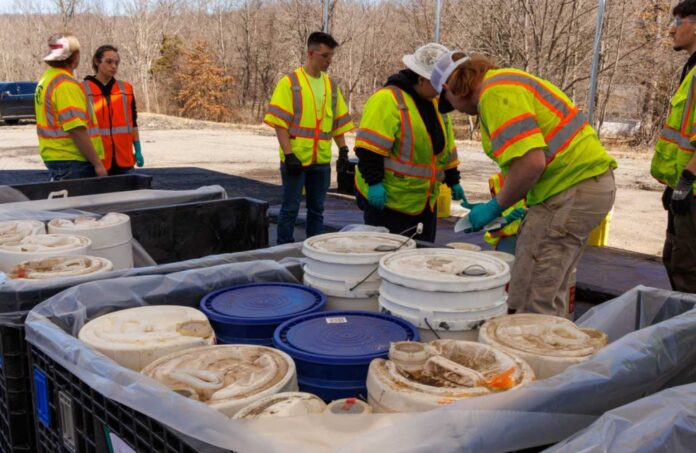
On March 20, the New Jersey Department of Environmental Protection (NJDEP) highlighted statewide firefighting foam-collection events, marking one of the largest coordinated programs of its kind in the United States.
The initiative was created to remove and destroy aqueous film-forming foam (AFFF) containing per- and polyfluoroalkyl substances (PFAS), commonly known as “forever chemicals,” from firehouses and fire academies across New Jersey.
Through these collection events, the state expects to safely collect and destroy over 150,000 gallons of AFFF — one of the most concentrated forms of PFAS. PFAS are synthetic chemicals linked to cancer, immune system complications and long-term environmental contamination.
Because they do not readily break down in nature, they can persist in water, soil and the human body. Removing AFFFs is considered a critical step states can take to reduce PFAS exposure.
To that end, the NJDEP hired Revive Environmental as the prime contractor to manage the full program, collaborating with Republic Services to deliver an end-to-end solution and overseeing collection-event coordination, transportation, storage and destruction.
The storage and destruction will be performed at Revive’s permitted facility in Columbus, Ohio.
“The DEP is delivering on one of the Sherrill administration’s environmental priorities to mitigate harmful PFAS, keeping them out of the environment and avoiding the extremely high cost of cleanup down the road,” said NJDEP Acting Commissioner Ed Potosnak.
Once collected, the firefighting foams are transported to Revive’s treatment facilities, where PFAS compounds are destroyed using the PFAS Annihilator, which employs supercritical water oxidation (SCWO) technology.
This process breaks chemical bonds apart and converts materials into benign mineralized byproducts, as verified through third-party analytical testing.
In 2025, other New Jersey entities aimed to mitigate PFAS, as well.
The New Jersey Institute of Technology (NJIT) and New Jersey Innovation Institute (NJII) announced the launch of PureTrace Labs, a startup created to bring NJIT-developed technology for rapid detection of PFAS to market.
Rowan University’s Dongmei Dong, Ph.D., an assistant professor in the Department of Physics & Astronomy in the College of Science and Mathematics, received a two-year, $200,000 grant from the National Science Foundation to develop an affordable, portable and easy-to-use alternative for detecting even trace levels of PFAS.
Additionally, Camden-based American Water and Calgon Carbon finalized a supply agreement to support PFAS treatment in 10 States.
For fire departments, the collection events provide a coordinated pathway for the responsible removal of AFFF.
For communities across New Jersey, the effort represents a meaningful step toward reducing long-term risks of PFAS exposure and protecting firefighters, residents and the environment.