Almost a year after Rutgers University officials approved a one-of-a-kind fusion of its two accredited medical schools into one larger entity, community skepticism still abounds. The school’s leaders hope to counter that.
All eyes are on the handling of the combination of the New Jersey Medical School in Newark and Robert Wood Johnson Medical School in New Brunswick, which are being transitioned into a singular institution with two regional campuses, referred to as the Rutgers School of Medicine.
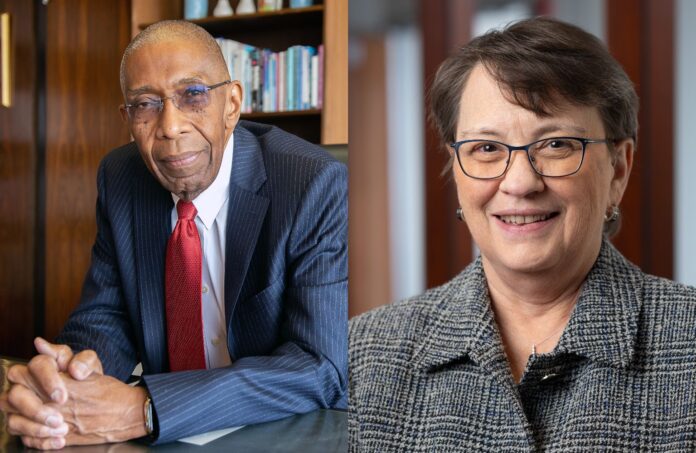
Robert Johnson, dean of the New Jersey Medical School, the state’s oldest medical school, said the goal since the Rutgers board of governors unanimously voted to approve the merger in July has been to make a concerted effort to listen and respond to criticism. Among the most outspoken critics have been faculty union leaders and Newark and Essex County officials.
“Understandably, there have been some people concerned about change,” he said. “And there have been all sorts of ideas people have developed that are not realistic, such as taking the school out of Newark and bringing it to New Brunswick or visa-versa.
“But there are also legitimate questions that we’re going about answering. And that, for us, has been an enjoyable task.”
The merger decision has drawn the ire of Newark Mayor Ras Baraka and other local leaders partly due to concerns about how it will affect University Hospital, which serves a large number of uninsured residents in the Newark community. Commentators have called for safeguards on that facility’s clinical services and assurances other resources wouldn’t be diverted to the RWJBarnabas Health private hospital system.
Johnson emphasized that there’s no change in the works for University Hospital and its relationship to the Rutgers schools. Legally, he said, there can’t be — they’re required by law to remain as a primary teaching hospital for University Hospital.
“We’re committed to providing health care in the community; training health care providers, physicians, nurses; and committed to participating in local health programs, such as HIV, COVID, lead poisoning and so on,” he said. “This is important to the city. So, any time we change something, there’s always a fear we’re going to abandon the city.”
That’s just one of the talking points the Rutgers administrators promoting the merger decision are taking to the community. Amy Murtha, dean of the Robert Wood Johnson Medical School in New Brunswick, is helping spearhead the “aggressive communication plan” the schools have put in place to engage students and stakeholders.
That work has involved the establishment of a task force, which held its first meeting in late March. Murtha said these meetings present opportunities to “share experiences and learn from each other.”
“Two schools that have historically been competing with each other have perspectives about each other that aren’t necessarily accurate,” she said. “The intent in the way this process is structured is really to build community across the campuses. We’ve seen that happening in a substantial way. And I think that culture-building work is probably one of the most important pieces we can do to create success with the Rutgers School of Medicine.”
Even if the Newark and New Brunswick institutions have both flown under the Rutgers flag, and are separated by just 35 miles, Johnson said that, as separate schools, there was a lot of competition between them for students, faculty and grants.
“And it really did not help us,” he said. “Size matters when it comes to medical schools. It means more grants, easier philanthropy and attracting more outstanding physicians and researchers.”
Once the accreditation process required for the merger is completed, the combined entity could be the largest medical school in the country. Certainly, it would likely be the largest medical school in the tri-state region. And it’s in those surrounding metropolitan areas, Philadelphia and New York City, that the school’s leaders view their biggest competition as coming from.
“And we weren’t doing a bang-up job of competing with them,” Johnson said. “Together, we’ll be in a better position to bring activity into the state.”
Johnson expects that having a premier medical school based out of New Jersey will benefit the local workforce and economy by hosting opportunities for advancing pharmaceutical-sector activities and other medical developments.
Murtha adds that the economic benefits could be realized by students as well — with the expectation being that a larger entity could allow for more leverage to reduce educational expenses, conceivably through more grants and philanthropy. The local medical schools currently rank in the 10th percentile for costs of in-state and out-of-state tuition.
“We’ve seen examples, like with the New York University School of Medicine and (Albert Einstein College of Medicine), of tuition-free programs,” Murtha said. “I’m not sure we’ll get there, but we do economically need to get to a better place to support the diverse population we have on our campuses, as they choose the specialties they want and become the doctors and medical professionals we desperately need.”
To finish the integration of the two medical schools, the institutions must seek a combined accreditation for their program through the Liaison Committee on Medical Education. After that several-year process, the Rutgers School of Medicine could be enrolling students by the 2028 academic year.
In the meantime, the schools’ leaders expect to continue responding to some of the public outcry that has trailed the merger since its announcement last year.
“Anytime you’re embarking on something as significant as this, the single most important thing to get organized is open and honest communication and listening to concerns,” Murtha said. “We can always do more, but we understand that we have to reach as many stakeholders as we can. We’re engaged, listening and open to feedback.”