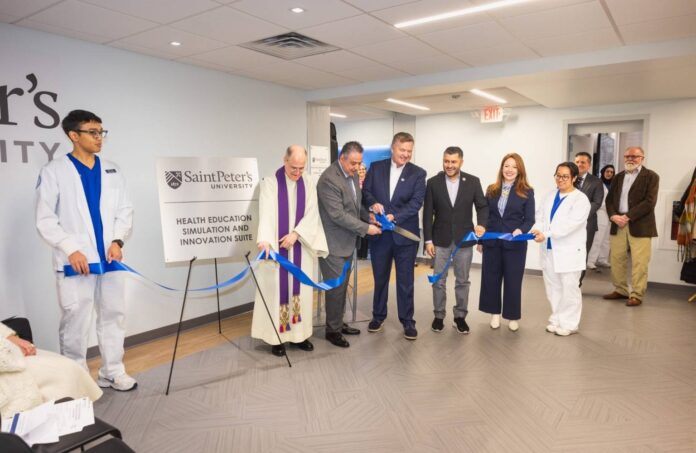
Saint Peter’s University said on March 23 that it officially marked the opening of its Health Education, Simulation and Innovation Suite at its School of Nursing and Health Professions with a ribbon-cutting ceremony. The Jersey City university unveiled a renovated, high-tech facility now in use for the Spring 2026 semester.
The university considers this event a milestone that reflects Saint Peter’s University’s commitment to advancing health sciences education into a new century to prepare the next generation of a health care workforce.
President Hubert Benitez and university leadership were joined by elected officials and community partners to celebrate the milestone.
Originally built in 1969, Pope Hall, home to the School of Nursing and Health Professions, now features a 12,000-square-foot, fully modernized facility that doubles the capacity of Saint Peter’s nursing programs while also providing shared access to advanced technology for other academic disciplines, fostering growth and promoting interdisciplinary education.
The main simulation lab, led by Anjalynn Deitmer, simulation lab coordinator, and Dr. Lisa Garsman, associate professor of nursing, features realistic patient care settings with individual beds, privacy screens and fully functional wall units. These elements reinforce best practices in patient-centered care, safety, and confidentiality while allowing students to practice in an authentic clinical environment.
Nursing students engage in hands-on training using advanced Laerdal manikins that simulate realistic physiological responses including vital signs, pulses, breathing patterns, cardiac activity and vocal cues, including expressions of pain. This innovative technology allows students to safely develop and refine clinical skills in procedures such as injections, wound care and intravenous (IV) administration.
The facility also includes a dedicated virtual reality area, where students work from individual pods to engage in immersive simulations, including multi-patient care, discharge processes and preparation for procedures such as catheterizations and CT scans. A flexible lab space supports classroom instruction with real-time demonstration capabilities.