
Hackensack Meridian Health has cared for as many COVID-19 patients as any health system in the state, and likely the country.
The total to date — and it’s growing every day — is more than 16,000 COVID-positive patients. At one point, during the first surge in March and April, the hospital was caring for more than 3,000 patients — 2,000 of whom were in their hospitals and more than 600 of whom were on ventilators in the ICU.
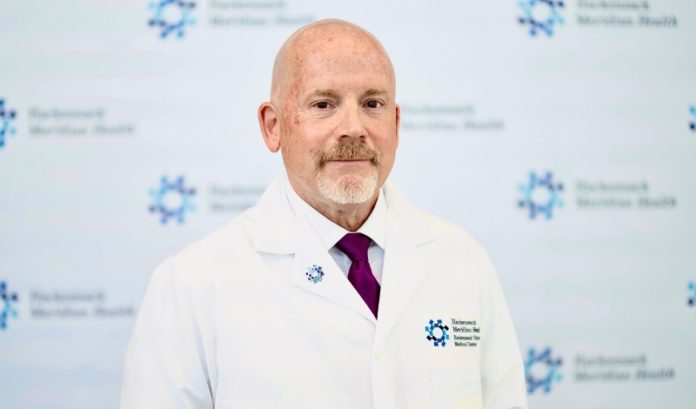
Dr. Dan Varga, the chief physician executive for the system — in simpler terms, the “Top Doc” — said the system is ready for the second wave. Somehow this summer, it found time to create a COVID 2.0 playbook — a 30-chapter handbook that details how HMH will manage patients, staff, facilities, personal protective equipment and everything else that comes with a pandemic.
Varga, however, knows the playbook doesn’t have all the answers. He said he and other HMH officials have three concerns regarding the second wave — which appears to be building.
Here they are:
No. 1: Keeping the (entire) hospital open
In the first wave, all of the hospitals in the state shut down virtually all non-COVID-specific services — all elective services and non-COVID emergencies were put on hold. That wasn’t a good thing.
“The model of care during that surge in March and April was very much a battlefield mentality,” Varga told ROI-NJ. “We were creating new ICU beds every day, we were redeploying physicians from physician offices into the hospital, nurses who were working on case management quality into the ICU, we were getting every licensed professional we possibly could into the hospital to help manage that cohort.
“We weren’t trying to run a real hospital at the time. And, what we realized is, as a community asset, we have to be able to continue to provide that unless we’re just in an extreme situation.”
This time, they know they can’t do that.
“This time, we’re hoping what we’re going to be able to do is to manage a wave of COVID patients without shutting down the rest of the hospital.”
This is a new challenge. One he says HMH already is feeling. Hospitalizations were down to 50 or so among the entire system just a month ago. Now, it is three and four times that number.
“Just that jump is putting pressure on us,” he said. “(Our) ability to handle surgical patients who need to have surgery. It’s backing up the ED because we do 100% testing of everybody that comes into the hospital. And we’ve got to get those people cohorted into COVID-negative and COVID-positive spaces.
“That’s the first issue that’s going to be a challenge for us as we move forward. I think we know how to do it. But it’s not something that that we’ve done when we’ve got big cohort of COVID.”
No. 2: Staffing up for the surge
When the first surge hit, HMH and other New Jersey systems could count on help from other health care workers in the state and around the country.
“We could redeploy doctors from the offices to the hospitals, we could call Texas and say, ‘Send us some nurses,’” he said.
This time, Varga said they know they can’t do that.
“COVID is everywhere now,” he said. “And everybody needs all their people.”
How do you staff when there’s no real reservoir of talent to go to? Varga said HMH has a plan.
“One of the most important things we did in the 2.0 playbook is really formalize how we think about redeployment,” he said. “How do you actually expectantly train a nonclinical individual to do clinical work? How do you expectantly train (someone) who works in the OR to work in the ICU?
“We’re trying to do in a in a proactive way, anticipatory kind of way.”
It’s a plan, Varga said, but no plan can account for burnout.
“This is a pooped, tired, brittle workforce,” he said. “They just lived through the surge. There’s a lot of PTSD out there after living on the front lines, watching patients get sick and die — and watching team members get sick and sometimes die.”
No. 3: Enough testing
This is the key to everything, Varga said.
“This is probably our biggest concern — believing that we have the testing capacity to do the cohorting and moving of patients in very rapid sequence and not all of a sudden get hung up with the fact that, ‘Oh, wow, we’re out of reagents, again, because the manufacturers can’t get them to us,’” he said.
Not enough tests would change everything.
“You would have triage tents full of people that you don’t know their status,” he said.
Varga said HMH is ready. He said it — and all the other health systems — will benefit from the fact they have been through this before and have a lot of good lessons learned. Even more, he said, the second wave will be a different part of the population.
Varga said those factors give him confidence.
Then there’s this: HMH and all other systems in the state are better prepared.
“We’ve 90 to 180 days’ stockpile of everything we need,” he said.
And they may not need as much. The next wave, Varga said, almost certainly will be younger people who need fewer services, shorter stays and will have a much higher recovery rate. And far fewer deaths.
Varga said the high number of fatalities — more than 15,000 — takes a toll on employees.
“That’s what really crushes a health care worker, when you’re doing everything you can and it’s not helping a huge population that you’re taking care of,” he said. “This (wave) seems to be different. It seems to be one where the acuity is lower. We’ll have to see how it plays out.
“But we’ve got to make sure we are remaining ultravigilant about our senior and chronically ill population.”